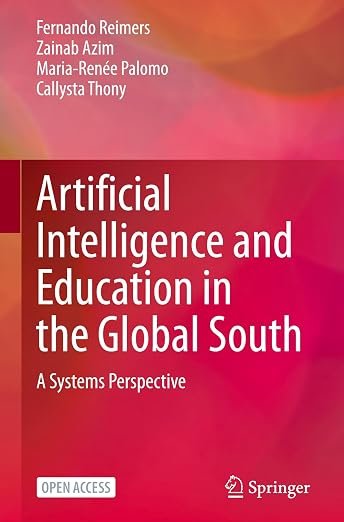
Artificial Intelligence and Education in the Global South
Fernando Reimers, Zainab Azim, Maria-Renée Palomo, and Callysta Thony
Artificial intelligence is rapidly changing the world of work, the production and use of knowledge, and the skills people need to participate fully in society. Artificial Intelligence and Education in the Global South examines whether—and under what conditions—AI can help education systems respond to these changes while improving learning, relevance, and equity.
The book adopts a systems perspective. Rather than treating AI as a stand-alone technological solution, it examines how its use interacts with curriculum, assessment, teacher development, school leadership, governance, infrastructure, financing, and institutional culture. The authors distinguish between applications that produce limited improvements and those capable of supporting lasting transformation at scale.
The focus on the Global South is especially important because these countries educate most of the world’s children and young people while often confronting limited resources, unequal access to technology, shortages of qualified teachers, weak infrastructure, and persistent learning gaps. In these settings, AI could help personalize instruction, support students with diverse needs, strengthen assessment, reduce teachers’ administrative burdens, improve professional learning, assist school leaders, and inform the allocation of scarce resources. Yet poorly designed applications could also deepen existing inequalities, reproduce bias, compromise privacy, weaken local agency, or divert attention from more urgent educational priorities.
Across chapters on student learning, curriculum, assessment, teacher development, school organization, and system governance, the book reviews emerging uses of AI, assesses the still-limited evidence of their effectiveness, identifies ethical concerns, and proposes questions for future research. It also argues that education systems must develop AI literacy—not only technical knowledge, but also the ability to use AI critically, work productively with it, understand its limitations, and evaluate its social and ethical consequences.
The book’s central message is that AI should serve educational purposes rather than define them. Its potential will depend on whether policymakers, educators, communities, and technology developers can align new tools with local needs, strengthen human capabilities, protect equity and dignity, and preserve the essential relationships at the heart of teaching and learning. Published by Springer in 2026, the book is available open access.